
All Virtual Meetings Start at 10:30am MT
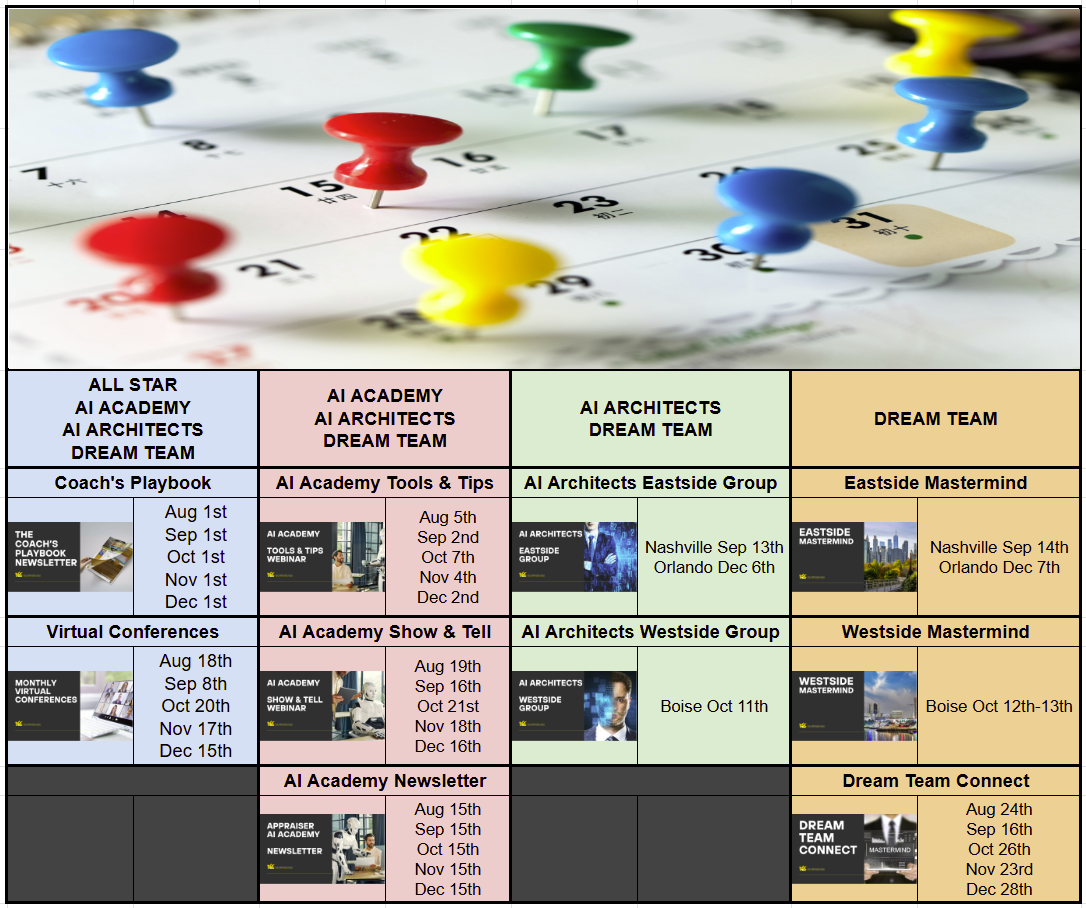
Add These Meetings to Your Calendar

Hey, I want to kick off September with something fun. We are running a community engagement contest, and I want you in on it. Our goal is to get every member posting and interacting in our Community Forum at least five to ten times a month, asking questions, dropping tips, and jumping into discussions. The member with the highest score at the end of the month wins a free coaching call with me, and we are announcing that winner this month. Here is how the points work: every post or comment earns you ten points, and every reaction gets you one point. Simple. So get in there, start talking, and let's build something great together.

Alright, let's talk about the elephant in the room: UAD 3.6. November is coming fast, and I know a lot of you are stressed about the software side of this thing. So let's just be honest about where we are.
There is no clear winner in the software race right now. None.
Most appraisers are sticking with Total, and look, I get it. But let's call it what it is: they're not staying because Total has blown everyone out of the water with some incredible 3.6 solution. They're staying because it requires the least amount of change. That's it. It's inertia. And I understand that impulse completely. When everything around you is shifting, you grab onto whatever feels familiar.

THIS INCLUDES ALL THE BENEFITS IN THE ALL STAR TEAM!
But inertia is not a strategy.
I've been watching this closely, and what I'm hearing from appraisers all over the country is frustration. People are testing different platforms, running reports in parallel systems, and realizing that the "safe" choice might not actually be the right choice for how they work. Every major software company is scrambling right now. Some of them are building brand new web-based platforms from the ground up. Others are trying to bolt 3.6 compliance onto desktop code that's been around for decades. Neither approach is painless, and neither one has clearly pulled ahead yet.
And here's the thing: the game has fundamentally changed. We're not filling out a static form anymore. We're feeding a dynamic database. The software that wins this race is going to be the one that actually understands that shift and builds something that makes it easier for appraisers to manage all that new data. Right now, I'm hearing about slow platforms, confusing navigation on the new dynamic condition and quality ratings, and crashes when people try to import from their mobile inspection apps. I'm hearing about workflows that made sense on the old forms but feel completely backwards on the new ones. Nobody has nailed it yet.
Now, I want to be fair. This is a massive undertaking for these companies. The scope of what UAD 3.6 requires is genuinely enormous, and I don't think any of them underestimated it. But the deadline doesn't care about their development timelines. November 2 is November 2. And we need to be ready, which means we need to be making smart decisions about our software right now, not just defaulting to whatever we've always used.
Here's my honest advice: if you haven't already, take two or three hours this month and actually test the 3.6 workflow in your current platform. Not a demo. Not a webinar. Actually sit down and try to complete a report from start to finish using the new forms. You will learn more in those three hours than in any amount of reading or watching videos. And if what you find makes you nervous, that's information you need to have now, not on October 31st.
The bigger problem is that we're all dealing with this in isolation. You're in your home office pulling your hair out over some weird glitch with a specific data field, and you think you're the only one. Meanwhile, somebody in Ohio figured out the workaround three weeks ago and has no idea you're struggling with the same thing. The software companies are essentially using us as beta testers, but we're not talking to each other.
That needs to change.
We need to start sharing what we're actually experiencing out in the field. If you've tried ACI's new platform, how does it actually feel three hours into a complex report? If you're using ClickForms, how are they handling the dynamic condition ratings? If you're sticking with Total, are the transition tools actually intuitive or do they feel clunky? I want to know. And more importantly, we all need to know.
This is exactly the kind of conversation that needs to be happening in our community right now. Not just complaining, actually sharing what's working, what's not, and what workarounds you've found. One appraiser's solution is another appraiser's lifesaver. That's the whole point of having a community like this.
Post in the group. Bring it up on the mastermind meetings. Shoot me an email. Let's figure out together who's actually winning this race. This should be based not on who has the most market share from people being too tired to switch, but based on who is actually making our jobs easier. The race is wide open. Let's make sure the right platform wins.

Let's talk about a niche that many appraisers overlook: tenant-in-common,
Since we're already talking about UAD 3.6, let me show you how AI can actually help you get ready for this transition without losing your mind in the process. The hardest part of 3.6 isn't the technology; it's the sheer volume of new definitions, new fields, and new compliance rules you have to get your head around. If you try to do that by just reading the Fannie Mae reference guide, I promise you, your eyes are going to glaze over by page three. Here's a better way.
First thing: use AI to build your new inspection checklist. Your old clipboard notes and your old mobile app templates are not going to cut it anymore. The data you need to collect at the property has changed. What you can do is take the UAD 3.6 requirement documents, upload them directly into ChatGPT or Claude, and ask it to pull out every single physical data point required for a standard single-family home. Then ask it to organize those data points in the order you actually walk through a house, starting with the exterior, then interior room by room. In a few minutes you'll have a custom 3.6-compliant inspection checklist that makes sure you never have to drive back to a property because you forgot to grab a new required field.
THIS INCLUDES ALL THE BENEFITS FROM THE LOWER TIERS!
Second: use AI as your personal 3.6 tutor. You're going to run into condition and quality rating scenarios where you're just not sure which category applies under the new dynamic definitions. Instead of guessing, build a custom GPT trained on the Fannie Mae guidelines. When you're mid-report and you're not sure how to handle something, such as a specific repair issue or an unusual quality characteristic, just type the scenario in and ask. It'll tell you the right categorization and give you the language to use in your addendum to back it up. It's like having a GSE underwriter on call.
Third: run your reports through an AI compliance check before you submit. The early weeks of 3.6 are going to be rough. Revision requests are going to fly. The GSEs are going to be watching data consistency closely. Set up a prompt that acts like a pre-underwriter and run your narrative sections through it before you hit send. It'll catch the contradictions your tired eyes missed, like when you wrote "average condition" in the addendum but accidentally clicked "poor" in the dynamic grid. Catching that before submission instead of after is going to save you a lot of headaches.
None of this requires you to be a tech wizard. You just need to be willing to experiment a little. Start with one of these three things this week and see what happens. The appraisers who are using AI to prepare for 3.6 right now are going to have a much smoother November than the ones who are waiting until the last minute.

Point #1: Perplexity AI
If you haven't tried Perplexity yet, do yourself a favor and go check it out today. It's basically a search engine that actually cites its sources, which means you're not just getting an AI guess; you're getting real information with footnotes you can verify. I use it for quick market research, looking up zoning stuff, and fact-checking economic data. Way faster than falling down a Google rabbit hole.
Point #2: Otter.ai
Stop typing your inspection notes. Seriously. Otter.ai transcribes everything automatically. Just talk while you're walking through the property and it turns your voice into a clean, searchable text transcript. You can also record phone calls with clients or borrowers and have the whole thing transcribed in minutes. It has saved a ton of time on report narratives.

I want to be real with you for a second. When I look at everything that's happening in our industry right now, including the 3.6 transition, the AI disruption, the software chaos, and the uncertainty about what the profession even looks like in five years, I totally understand why some of you are feeling overwhelmed. If you're sitting alone in your home office trying to figure all of this out by yourself, it can feel like a lot. Like, a lot a lot.
But here's what I keep coming back to: you don't have to do this alone.
That's the thing that hit me hardest coming out of Salt Lake City. When you get the right people in a room together (people who are actually working on their businesses, actually paying attention to what's happening, actually trying to get better) something shifts. The fear doesn't disappear, but it gets smaller. Because suddenly you realize that the person sitting across from you is dealing with the same stuff you are, and they found a way through it, and now they're sharing it with you. That's what community does.

The appraisers who came to Salt Lake didn't leave with all the answers. Nobody does. But they left knowing they weren't alone in the fight. They left with people in their corner. And when the 3.6 rollout gets messy, and it will get messy, they have a group they can call on.
The worst thing you can do right now is isolate yourself. Don't white-knuckle your way through this transition. Get in the community. Post in the group. Show up on the mastermind check up calls. Come to the live events when you can. Ask your dumb questions; I promise they're not dumb. Share what you're figuring out, because someone else needs to hear it.
The appraisers who thrive in the next few years are going to be the ones who figured out that we're stronger together. Find your people. Get in the room. You'll be amazed what happens when you do.
Now, go create some value!