

Add These Meetings to Your Calendar
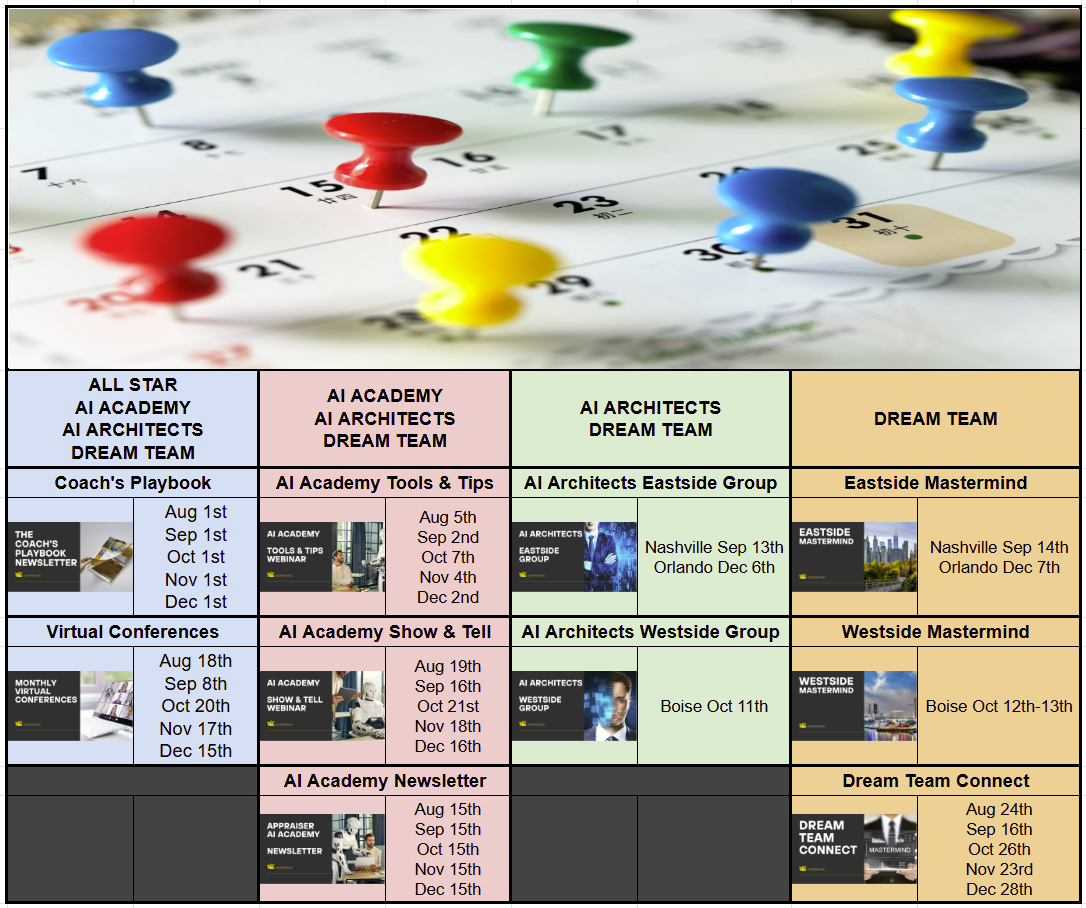
All Virtual Meetings Start at 10:30am MT

Seven Models in One Month, and the Only One That Matters Is Yours

The Release Pace Broke, and Even the Industry Noticed
What happened: The first week of September produced the densest run of frontier model launches of the year. Anthropic shipped Claude Fable 5.1 and Mythos 5.1 on September 1. Google followed with Gemini 3.8 Flash on September 2. OpenAI released GPT-6 Astra. Counting Meta and Qwen, seven significant models landed inside a few weeks. CNBC ran a piece on September 6 about "model fatigue," which is the industry's own word for what happens when the labs ship faster than anyone can evaluate.
Why it matters to appraisers: you are not behind. There is no version of paying attention that keeps up with seven models a month, and the people telling you otherwise are selling something. The practical response is to stop trying to pick the permanent winner and start making your own context portable, so that whichever model is best in November costs you nothing to move to. That is the entire argument behind this month's Jobsite section, and it is the most useful thing you can do with an afternoon.

Running Your Own Tools Just Got Cheaper
What happened: Alongside Fable 5.1, Anthropic cut the price of cache reads to roughly a quarter of what the previous model charged. Cache reads are what you pay when a model re-reads context it has already seen. If you have built anything that repeatedly loads the same documents, your guidelines, your templates, your report standards, that is the line item that was quietly costing you money.
Why it matters to appraisers: this is the unglamorous kind of news that actually changes what is worth building. A tool that re-reads a 60 page AMC guideline on every run was expensive to operate a year ago. It is substantially less so now. If you priced out an idea months ago and walked away because the running cost did not justify it, the arithmetic may have changed underneath you. Worth rechecking before you assume it is still out of reach.

The Models Are Now Powerful Enough to Have Their Own Guardrails
What happened: OpenAI reported that GPT-6 Astra was the first of its models to cross an internal safeguard threshold related to cyber capability, which triggered additional protections around its release. Set aside the specifics for a moment. The notable part is that a frontier lab now publishes a threshold, tests against it, and says out loud when a model crosses it.
Why it matters to appraisers: this is a useful reality check in both directions. These systems are considerably more capable than the chatbots most appraisers still picture, which is the case for taking them seriously. It is also the case for being deliberate about what you connect them to. Before you point any model at a folder, know what is in that folder. Client files, borrower information, and anything covered by an engagement deserve a decision, not a default. Read your own client requirements and your confidentiality obligations before you wire anything to a live file system.

Stop Guessing at 3.6 Three Weeks Before the Mandate

Claude Projects: A UAD 3.6 Answer Desk Built From the Actual Documents
The UCDP mandate lands November 2. Between now and then, every appraiser in the country is going to hit the same wall: you are mid report, you are not sure how 3.6 wants a specific thing handled, and your options are to guess, to dig through a reference guide, or to post the question in a forum and hope somebody who actually knows answers before your due date.
There is a fourth option, and it takes about fifteen minutes to set up.
A Project in Claude, a Gem in Gemini, or a Custom GPT in ChatGPT is a container you load with your own documents once and then ask questions against forever. Load it with the actual GSE material, the UAD 3.6 specification, the Fannie and Freddie job aids, the photo and image requirements, your own client guidelines, and you have built yourself an answer desk that reads from the source instead of from memory.
BEST FOR: Getting a sourced answer to a specific 3.6 question in the middle of a report, without leaving the file or waiting on a forum.
TIME SAVED: Setup is roughly 15 minutes. After that it replaces the ten to twenty minutes you currently lose every time you go hunting for one answer in a long PDF.
DIFFICULTY: Beginner

Load It, Then Make It Prove Where the Answer Came From
Create a new Project. Upload the current GSE UAD 3.6 documents. The photo and image requirements job aid is free from Freddie Mac and is the single most useful one to start with. Add your own client and AMC guidelines if you have them in writing. Then set the Project instruction to something like this:
- "You are a reference desk for the UAD 3.6 redesigned URAR. Answer only from the documents loaded in this Project. For every answer, quote the exact language you relied on and name the document and section it came from. If the loaded documents do not clearly answer the question, say so plainly and tell me what document would. Never infer a requirement that is not stated. I am the appraiser and I am responsible for the report, so I need to be able to check your work against the source."
That last instruction is the whole point. An answer you cannot trace is worse than no answer, because it feels like knowledge. Requiring the quote and the citation turns the tool from something that sounds confident into something you can actually verify in ten seconds.
Then use it on a real file this week. When you hit a question, ask the desk, then open the document it cited and confirm the language yourself. Do that five or six times and you will have a calibrated sense of where it is reliable and where it is not, which is knowledge no webinar can give you.
One caution. Load only documents you have the right to load, keep client and borrower material out of it unless you have checked your engagement and your platform's terms, and remember that a citation to a document is not the same thing as the document being current. Verify against the live GSE source before you rely on anything for a report you sign.

Recap of the Last AI Academy Meeting

On September 2 we held an Academy teaching session on the thing Dustin has been building since June: the Dustin OS Brain, a personal knowledge system that any AI can read. He credited the concept to Nate B. Jones and his Open Brain project, then showed the deliberately simpler version he built for a small appraisal business. Three ingredients, and that is genuinely all of them. Plain markdown files. A folder to keep them in, either on your own machine or in something like Obsidian. And MCP connectors, which are just the bridge that lets different AI tools read that same folder.
The build is five steps. Create your North Star documents, which are the durable facts about you and your business. Put them somewhere you control and back them up. Connect your approved tools through MCP. Test it by asking "what do you know about my business?" Then maintain it during your weekly OINII time, because a second brain that never gets updated is just an old brain.
Two things landed hardest with the room. First, he made his North Star documents by talking into a recorder on a four hour drive, not by sitting down to write. Perfection is the enemy of done, and anything you forget can be added the first time the system does not know it. Second, put a summary at the top of every markdown file and the detail underneath. AI reads top down, so a file that opens with its own summary is faster and cheaper to use than one that does not.
The payoff is the part people underestimate. Work through an idea in one model in the morning, open a different one in the afternoon, and pick up where you left off, because the context lives in your files rather than in a chat history you cannot export.

The best moment was not a question. Dustin opened by admitting that he had barely touched the system in a week because he had been in the mountains with his boys, that he sat down that morning and found both of his connections dead, and that it took him about ten minutes to rebuild them using Claude as his guide. Then he said he hoped something else broke during the session so the group could fix it together.
That is worth more than a clean demo. His words were that reality is not jumping on YouTube and announcing you built a robot that shines your shoes. If you joined the Academy for a magic pill, you joined the wrong club, and that club does not exist. He is not a coder, he says so constantly, and he still tells Claude to slow down and talk to him like a sixth grader. The room got the honest version, which is the only version worth teaching from.

The full recording is available in the Appraiser AI Academy

What the AI Architects Built This Past Month

The Nashville Build: A Comp Selection and Adjustment Teardown
On September 13 in Nashville, the Architects spent the day building a tool with one job: attack your own grid before a reviewer or an opposing attorney gets the chance. The premise is that when your work gets taken apart, the argument is usually not that your value is wrong. It is that your support is thin.
So the tool goes after the things that actually lose arguments. Comps bracketed on the wrong parcel size, when price per acre falls as acreage rises. Unusable or encumbered land averaged in at dry ground value. Road frontage, water, utilities. And every adjustment that is asserted rather than supported.
Dustin built and tested it first, then the room built it together, so each person left owning a working copy rather than a memory of a demo. Your laptop, your tool.
This is what a Sunday with the Architects looks like. Real builds, real problems solved. If you're in the AI Academy and want access to the workflow and prompt files, it's time to consider Upgrading

Your Monthly Challenge — Small & Doable — Feeds the Next Month's Show & Tell

Build the Answer Desk and Try to Catch It Being Wrong
Set up the UAD 3.6 answer desk from Section 02. Fifteen minutes, one Project, the free GSE job aids loaded in. Then take three real questions off a file you are actually working on and ask it.
Here is the part that matters. For each answer, open the document it cited and check the language yourself. Write down what it got right, what it got wrong, and anything it claimed without a source. You are not grading the tool. You are calibrating your own trust in it, three weeks before you have to rely on something. Better to find the edges now, on a file you can double check, than on November 3 with a due date on top of you.

Post your before-and-after in the AI Academy Forum on the Appraiser Coach Community and tag it #PunchList. The most interesting submissions get featured in next month's newsletter — and Dustin reads every single one.

